If you or someone you love has started forgetting things whether it’s missing appointments or struggling to recall a recent conversation—it’s natural to feel concerned. Memory loss can be unsettling, but understanding its cause is the first step toward getting the right help. While both amnesia and dementia involve memory problems, they are not the same condition.
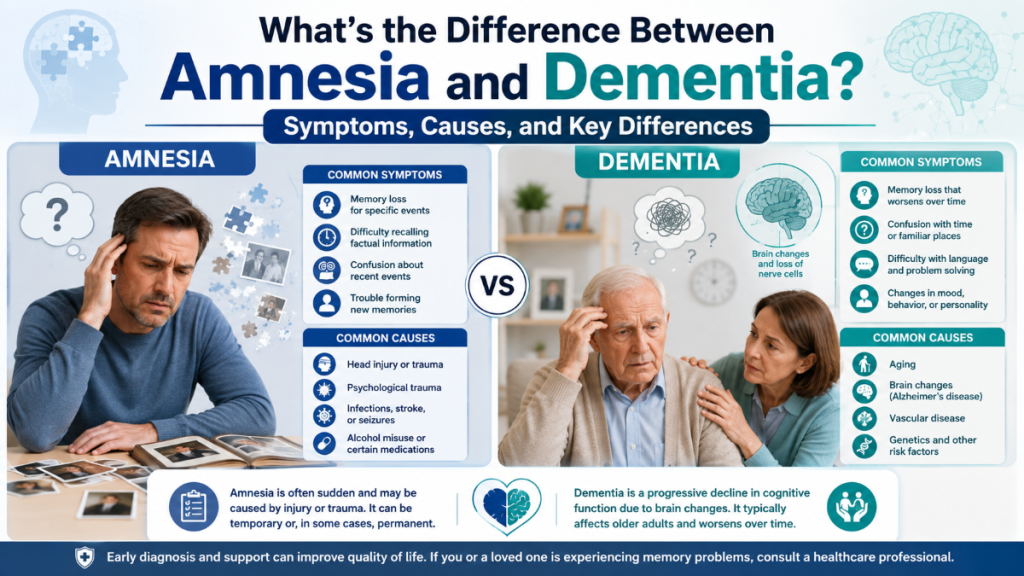
Amnesia is a type of memory loss that is often temporary and primarily affects the ability to form new memories or recall past information . Dementia, on the other hand, is a progressive decline in cognitive function that goes beyond memory—it affects thinking, reasoning, judgment, and the ability to perform everyday tasks . In this guide, you’ll learn the key differences between these conditions, their symptoms, causes, and when to seek medical attention.
Amnesia vs. Dementia: Quick Comparison
| Feature | Amnesia | Dementia |
| Main condition affected | Memory only | Memory, thinking, judgment, language, behavior |
| Onset | Often sudden (head injury, stroke, seizure) | Usually gradual (months to years) |
| Progression | May improve or resolve; can be permanent in some cases | Progressive and worsens over time |
| Cognitive abilities affected | Memory (new learning and/or past recall) | Multiple domains: memory, language, executive function, attention, visuospatial skills |
| Daily functioning | Usually preserved | Significantly impaired over time |
| Treatment | Treat underlying cause; supportive strategies | Symptom management; no cure; lifestyle interventions |
| Potential reversibility | Often reversible if cause is treated | Rarely reversible; some reversible mimics exist |
What Is Amnesia?
Amnesia, also referred to as amnestic syndrome, is a deficit in memory caused by damage to brain structures critical for processing and recalling information . Unlike what we see in movies, people with amnesia typically know who they are. However, they may have difficulty learning new information or remembering past events .
How Amnesia Affects Memory
Amnesia primarily impacts short-term or recent memory. Someone with amnesia might be unable to remember what they ate for breakfast or the name of the current president, yet they can recall childhood memories or play an instrument .
Importantly, isolated memory loss does not affect intelligence, judgment, personality, or identity . People with amnesia can usually understand language, carry on conversations, and continue learning skills.
Anterograde Amnesia
This is the inability to form new memories after the onset of the condition . Someone with anterograde amnesia may forget events that occurred just minutes ago, even though they can recall events from before the injury or illness.
Retrograde Amnesia
This involves the loss of past memories that existed before the amnesia began . A person may forget personal history, important life events, or previously familiar information.
Other Types of Amnesia
- Transient Global Amnesia: A sudden, temporary episode of memory loss that usually lasts less than 24 hours. The cause is often unknown .
- Dissociative Amnesia: Memory loss resulting from emotional shock or trauma, such as surviving a violent crime .
- Wernicke-Korsakoff Syndrome: A chronic memory disorder caused by severe vitamin B1 (thiamine) deficiency, often associated with long-term alcohol misuse .
What Is Dementia?
Dementia is not a single disease. It’s an umbrella term for a range of progressive conditions characterised by cognitive decline . Alzheimer’s disease is the most common type, accounting for 60–70% of cases .
Why Dementia Is More Than Memory Loss
While memory loss is often the first symptom, dementia affects multiple cognitive domains . The decline is significant enough to interfere with daily independence .
Cognitive Abilities Dementia Can Affect
- Language: Difficulty finding words or understanding speech.
- Executive function: Problems with planning, organising, and problem-solving.
- Attention: Reduced ability to focus or concentrate.
- Visuospatial skills: Difficulty navigating, recognising faces, or judging distances.
- Judgment: Poor decision-making and impaired reasoning .
Common Types of Dementia
| Type | Characteristics |
| Alzheimer’s Disease | Progressive memory loss, confusion, personality changes |
| Vascular Dementia | Caused by reduced blood flow to the brain; often linked to stroke |
| Lewy Body Dementia | Memory loss with visual hallucinations, movement problems, and fluctuations in alertness |
| Frontotemporal Dementia | Affects personality, behaviour, and language; often occurs at younger ages |
What Is the Main Difference Between Amnesia and Dementia?
Amnesia Primarily Affects Memory
Amnesia is a narrow condition limited to memory impairment. It does not affect other cognitive abilities like reasoning, language, or judgment .
Dementia Affects Memory and Other Cognitive Abilities
Dementia is a broad condition that affects multiple areas of brain function. Alongside memory loss, it impacts language, executive function, and daily independence .
How Dementia Can Affect Daily Independence
As dementia progresses, a person may no longer be able to manage finances, prepare meals, take medications, or even recognise loved ones. This has significant implications for safety and care. For guidance, you can explore whether can someone with dementia live alone.
Amnesia vs. Dementia Symptoms
Common Symptoms of Amnesia
- Difficulty forming new memories (anterograde)
- Difficulty recalling past events (retrograde)
- Confusion or disorientation
- Occasionally, false or misplaced memories
Common Symptoms of Dementia
- Progressive memory loss that worsens over time
- Losing things or getting lost in familiar places
- Difficulty completing daily tasks
- Personality and mood changes
- Language problems
- Forgetfulness of recent events
- Difficulty retaining new information
- Confusion
When Memory Problems Become Concerning
Memory loss that is persistent, worsening, or interfering with daily life warrants medical evaluation. Simple tests like the 5 word memory test can help assess short-term memory. Learn more about the signs and symptoms of dementia.
Sudden Memory Loss vs. Gradual Cognitive Decline
Can Amnesia Start Suddenly?
Yes. Amnesia can begin suddenly, often due to a head injury, stroke, seizure, or transient global amnesia . Sudden onset requires immediate medical attention.
Does Dementia Develop Gradually?
Yes. Dementia typically has a slow, insidious onset that progresses over months or years . Early signs are subtle and often missed.
Why Sudden Confusion or Memory Loss Needs Medical Attention
Sudden confusion (delirium) or memory loss can indicate a medical emergency such as stroke, infection, or medication toxicity. If it occurs, seek urgent care. Learn more about traumatic brain injury and memory loss.
What Causes Amnesia?
Head Injuries and Brain Trauma
Concussions and severe head trauma can damage brain regions responsible for memory .
Neurological Conditions
- Stroke
- Brain inflammation (encephalitis)
- Seizures
- Brain tumours
- Lack of oxygen to the brain
Medications, Substances, and Medical Conditions
- Sedatives and benzodiazepines
- Long-term alcohol misuse (leading to vitamin B1 deficiency)
- Certain medications
Psychological Causes of Memory Loss
Dissociative amnesia following trauma or extreme stress . For more, visit causes of memory loss and amnesia.
What Causes Dementia?
Alzheimer’s Disease
The most common cause, involving nerve cell damage and brain atrophy .
Vascular Dementia
Resulting from impaired blood flow to the brain, often after strokes .
Lewy Body Dementia
Characterised by abnormal protein deposits in the brain .
Frontotemporal Dementia
Affects the frontal and temporal lobes; often leads to personality and language changes .
Other Conditions That Can Cause Dementia Symptoms
- Parkinson’s disease
- Huntington’s disease
- Normal pressure hydrocephalus
- Vitamin B12 deficiency
Explore dementia symptoms, types, and diagnosis.
Normal Aging vs. Amnesia vs. Dementia
Normal Age-Related Forgetfulness
Occasional forgetfulness—like misplacing keys or forgetting a name—is part of normal aging. It does not interfere with daily life .
Memory Problems That May Be More Concerning
- Forgetting entire events
- Inability to learn new information
- Getting lost in familiar places
When Memory Loss Starts Affecting Everyday Life
If memory loss interferes with work, social activities, or self-care, it requires evaluation. Learn more about memory problems, forgetfulness, and aging.
Amnesia vs. Dementia vs. Mild Cognitive Impairment
What Is Mild Cognitive Impairment?
Mild Cognitive Impairment (MCI) involves cognitive changes that are noticeable but not severe enough to impact daily functioning .
Mild Cognitive Impairment vs. Dementia
When cognitive decline begins to interfere with daily independence, it is classified as dementia .
Does Mild Cognitive Impairment Always Become Dementia?
No. MCI is a risk factor, but not everyone progresses to dementia. Some cases remain stable or improve. Explore mild cognitive impairment.
Amnesia vs. Dementia vs. Delirium
What Is Delirium?
Delirium is a sudden, acute state of confusion, often caused by infection, medication, or metabolic imbalance. It is usually reversible .
Sudden Confusion vs. Progressive Cognitive Decline
Delirium develops over hours to days; dementia develops over months to years .
Why Delirium Can Be Mistaken for Dementia
Because both involve confusion and disorientation. However, delirium is acute and fluctuating, while dementia is chronic and progressive .
Amnesia, Dementia, and Alzheimer’s Disease: What’s the Difference?
Is Alzheimer’s the Same as Dementia?
No. Alzheimer’s is a specific cause of dementia—the most common one .
Is Amnesia the Same as Alzheimer’s?
No. Amnesia is a symptom of Alzheimer’s, but Alzheimer’s also affects many other cognitive functions .
Can Alzheimer’s Cause Memory Loss?
Yes, memory loss is the hallmark early symptom of Alzheimer’s. Discover how Alzheimer’s affects the senses. For more, read about Alzheimer’s disease.
How Doctors Diagnose Amnesia vs. Dementia
Medical and Memory History
Doctors take a detailed history from the person and family members to understand onset, progression, and impact .
Cognitive and Memory Tests
Screening tools assess orientation, attention, short-term memory, language, and visuospatial skills . Try the 5 word memory test.
Neurological Examination
Evaluates reflexes, coordination, sensory function, and primitive reflexes that may indicate frontal lobe issues .
Brain Imaging and MRI
MRI or CT scans can detect strokes, brain tumours, or normal pressure hydrocephalus. See MRI and early signs of dementia.
Laboratory Tests
Blood tests check for reversible causes such as vitamin B12 deficiency, thyroid disorders, or infections .
Why Family and Caregiver Observations Matter
Family members often notice subtle changes earlier than the person affected. Their observations are critical for diagnosis .
Questions to Ask a Doctor About Memory Loss
When Did the Memory Problem Begin?
Is the Memory Loss Getting Worse?
Are Other Thinking Abilities Changing?
Is Daily Independence Being Affected?
What Information Should a Caregiver Bring?
Bring a medication list, details of symptoms, and observations about daily functioning. Use this caregiver checklist for doctor visits.
How Are Amnesia and Dementia Treated?
Treatment Options for Amnesia
Treatment targets the underlying cause. For example, vitamin B1 for Wernicke-Korsakoff syndrome, or discontinuing offending medications. In many cases, memory improves over time .
Treatment and Management for Dementia
There is no cure, but cholinesterase inhibitors and memantine can modestly improve symptoms . Lifestyle interventions—physical activity, social engagement, and managing cardiovascular risk—are crucial .
Memory and Daily-Living Strategies
- Use calendars, alarms, and organised routines
- Label cupboards and household items
- Break tasks into simple steps
When Memory Care May Be Needed
As dementia progresses, care needs increase. Learn about the difference between memory care and dementia care.
Can Amnesia or Dementia Be Reversed?
When Amnesia May Improve
Amnesia often resolves if the underlying cause is addressed—such as a head injury healing or medication being withdrawn .
Can Dementia Be Reversed?
Most dementia is irreversible. However, some reversible conditions mimic dementia, including:
- Vitamin B12 deficiency
- Hypothyroidism
- Normal pressure hydrocephalus
- Depression (pseudodementia)
Reversible Conditions That Can Mimic Dementia
These conditions can cause cognitive symptoms that improve with treatment. Proper evaluation is essential .
Real-Life Examples: Amnesia or Dementia?
Scenario 1: Memory Loss After a Head Injury
A person with a concussion may struggle to remember events from the previous day. This is amnesia and often improves with time.
Scenario 2: Gradually Forgetting Appointments and Familiar Tasks
A person who repeatedly misses appointments, struggles to manage finances, and gets lost in their neighbourhood may have early-stage dementia.
Scenario 3: Sudden Confusion During an Illness
An older adult with a urinary tract infection becomes acutely confused and disoriented. This is likely delirium, not dementia.
When Should You See a Doctor for Memory Loss?
Persistent or Worsening Memory Problems
If memory loss does not improve or is getting worse, seek evaluation.
Memory Loss That Affects Independent Living
When memory problems affect driving, cooking, medication management, or finances, it is time to act. Explore whether can someone with dementia live alone.
When Sudden Memory Loss Is an Emergency
Sudden confusion, memory loss, or disorientation warrants immediate medical attention. Learn about signs of dementia.
Key Differences Between Amnesia and Dementia
| Aspect | Amnesia | Dementia |
| Memory impairment | Primary and often isolated | One of several affected domains |
| Other cognitive impairment | None or minimal | Language, judgment, executive function impaired |
| Sudden vs. gradual onset | Often sudden | Usually gradual |
| Progression | May improve or stabilise | Progressive decline |
| Effect on independence | Minimal | Significant over time |
| Causes | Trauma, stroke, seizure, psychological | Neurodegenerative diseases, vascular |
| Treatment and prognosis | Treat underlying cause; often reversible | Symptomatic management; generally irreversible |
Frequently Asked Questions
Can Amnesia Turn Into Dementia?
Amnesia itself does not become dementia. However, some conditions that cause amnesia—such as Alzheimer’s disease—are also forms of dementia. In these cases, additional cognitive symptoms will emerge.
How Do You Know if Memory Loss Is Dementia?
Memory loss is part of dementia if it is progressive and accompanied by other cognitive changes—such as language problems, poor judgment, and difficulty performing daily tasks—that interfere with independence.
Can Someone With Amnesia Still Think Normally?
Yes. Amnesia primarily affects memory without impairing intelligence, reasoning, language, or judgment. People with amnesia can usually think clearly, hold conversations, and learn skills like riding a bike.
Is Amnesia Temporary While Dementia Is Permanent?
Amnesia is often temporary, especially if caused by a reversible condition like head injury or medication side effects. Dementia is generally permanent and progressive, though symptoms can be managed.
What Is the Difference Between Short-Term Memory Loss and Dementia?
Short-term memory loss is a symptom, not a diagnosis. It can be caused by amnesia, dementia, normal aging, or other conditions. Dementia involves memory loss plus other cognitive impairments that affect daily life.
Final Thoughts
Understanding the difference between amnesia and dementia is crucial for getting the right help at the right time. Amnesia is primarily a memory problem often temporary and treatable. Dementia is a broader, progressive decline that affects memory, thinking, and daily functioning.
If you or a loved one are experiencing memory concerns, don’t ignore them. Early evaluation can identify reversible causes, rule out serious conditions, and open the door to treatments and strategies that improve quality of life.
Take the next step: Use the resources in this guide, prepare questions for your doctor, and bring a caregiver checklist to your next visit. You are not alone support and clarity are available.